About Us

Showing posts with label Historic Site. Show all posts

Friday, March 4, 2016

The Pony Express Starting Point in St Joseph, MO

In late October, we took a short trip up the Missouri River to St Joseph.  We stopped by the Pony Express Statue on the north side of downtown first.  
Then we went to the Pony Express Museum located in the Pony Express Stable.  The Pony Express was an exciting and colorful part of US history, although it only lasted for 19 months, at which point the telegraph line from coast to cost was completed.  
Inside the museum, you learn about Russell, Majors, and Waddell, who founded the Pony Express with the idea of rapidly reducing the amount of time it took for mail to get from California to the earstern US and vice versa.  They did so by getting rid of wagons, and employing young boys to ride fast horses between stations, each rider only carrying the mochila (mail pouch) and gun.  The riders were usually in their teens or early 20's.
The Pony Express Stable was a fascinating stop.  We spent several hours learning about the trail, different terrains the riders passed through, experiences some of the riders had, what mail stations were like, and many other things.

Nearest City: St Joseph, MO
Location: 914 Penn St, St Joseph, MO  64503
Time Needed: 2+ hours
Difficulty: easy
Kid Friendly: yes
Additional Info: ponyexpress.org

Thursday, November 26, 2015

Mark Twain, Tom Sawyer, and Hannibal, MO

On our drive home from Nauvoo, we made a short sidetrip to Hannibal, Missouri.  The downtown is cute, with lots of little shops along the sidewalks,  Most famous for its tie to Mark Twain, and the hometown of fictional Tom Sawyer, Hannibal is a place to visit if you're a fan of great American writing.  
Just off the north end of Main Street is a full block of Tom Sawyer related sites.  The kids wanted to take a turn "painting" Tom Sawyer's fence.  
There were also several buildings spoken of in Tom Sawyer, such as Aunt Polly's House and Becky Thatcher's house.

Nearest City:Hannibal, MO
Location: N° W°
Time Needed: 2 hours
Difficulty: easy
Kid Friendly: more for older kids
Additional Info:

Wednesday, July 29, 2015

The Susan B Anthony Home in Leavenworth

Susan B. Anthony lived in Leavenworth for a while.  She advocated for women's rights, such as the right to vote.  Although she died 14 years before the 19th Amendment was passed, she was very influential in advocating for women.

Although she did not own this house, her brother did, she lived in it for a time.

From Leavenworth website:

Daniel Read Anthony, born on February 15, 1820 and his sister, Susan Brownell Anthony, born on August 22, 1824, had tremendous influence over the course of events in Kansas and the nation. Daniel's influence was felt through his newspaper and Susan was internationally known as an advocate of the early campaign for woman suffrage.
Daniel Anthony settled in Leavenworth in 1857 and founded the Leavenworth Conservative Newspaper in 1861. In January 1861, Colonel Anthony printed a special report announcing Kansas's statehood. Since Leavenworth was the western ending point of the telegraph, Colonel Anthony rode thirty-two miles on horseback to Lawrence to inform the territorial legislature of the news.
Daniel Anthony helped to form the Seventh Kansas Cavalry and was commissioned as a lieutenant colonel. During the Civil War he commanded a brigade in Tennessee.
In 1871, Colonel Anthony purchased the Leavenworth Times, the oldest daily newspaper in Kansas. During this time, frontier editors of strong convictions, like Colonel Anthony, had to be willing to defend themselves. Due to an article Colonel Anthony wrote, a rival publisher, R.C. Satterlee of the Kansas Herald, suggested that Colonel Anthony was a coward. The two men met on the street and Colonel Anthony demanded a retraction, which Mr. Satterlee refused to do. The men exchanged gunfire and Mr. Satterlee was mortally wounded. A jury of his peers acquitted Colonel Anthony.
In another incident in 1875, Colonel Anthony was severely wounded when William Embry, editor of the Daily Appeal, fired at him when he entered the Leavenworth Opera House. Colonel Anthony was not expected to live and Susan came to be with her brother. Colonel Anthony survived and lived to the age of 80. He died of natural causes in 1904. The Anthony Family continued to publish the Leavenworth Times until the late 1960s.
Susan Anthony was a schoolteacher who, after meeting Elizabeth Cady Stanton in 1854, determined to devote her life to the struggle of women's rights. She became internationally known for her work as a suffragist and was the foremost advocate for women's rights in America. Miss Anthony visited her brother at this home on the Esplanade on numerous occasions and lived in Leavenworth for several months in 1865 and helped edit the newspaper.
In 1872, in a plan to test the 14th Amendment of the Constitution which granted citizenship to black males, Susan B. Anthony registered and voted in the presidential election. She was arrested and put on trial. The judge directed the jury to bring a verdict of guilty and impose a $100 fine. She refused to pay it but the judge declined to put her in jail.
Miss Anthony traveled across the country campaigning for the rights of women often lecturing in Leavenworth. In 1875 she spoke at the Occidental Hall in Leavenworth. Admission to her lecture was 25 cents.
She lobbied every session of Congress from 1869 until her death to persuade lawmakers to accept a suffrage amendment to the Constitution. The 19th Amendment of the Constitution, granting women suffrage, did not pass until 1920, a hundred years after Susan B. Anthony's birth and 14 years after her death in 1906. At the time of her death women could vote in only 4 states, but Susan, more than any other, had opened the way for the adoption of the 19th Amendment. It was introduced in the U.S. House of Representatives by Miss Anthony's nephew. Representative D. R. Anthony, Jr. of Leavenworth.
Miss Anthony was twice honored on U.S. postage stamps, and on the dollar coin minted in 1979. She wrote a book that consists of two volumes and nearly 2000 pages called "The History of Women's Work. She has been called the greatest woman this country has produced. She saw the vote as a symbol of women's emancipation and independence, as well as the indispensable condition of true republican government.


Nearest City: Leavenworth, KS
Location: 515 N. Esplanade, Leavenworth KS
Time Needed:5 minutes
Difficulty: easy
Kid Friendly:
Additional Info: Leavenworth Historical Tour Locations

Saturday, July 25, 2015

Harry S Truman National Historic Site and the beginning of the Oregon Trail

While we were Independence, we visited several of the Harry S Truman sites.  We stopped at the visitor center and watched a short movie about him, his presidency, and his ties to Independence.  It was very informative.  He was famous for the saying "The Buck Stops Here". 
Before his political career, he was a Judge in Independence, with an office here at the courthouse in downtown Independence.  There is a statue of him on the east side of the courthouse. 
On the west side of the courthouse, there are two large monuments.  The one on the north marks the Courthouse Square as the beginning of the Oregon Trail. 
Off to the south is a stone monument marking the beginning of the Santa Fe Trail.  We stopped by the nearby National Frontier Trails Museum for a great overview of westward migration and the roles that these two trails had in the opening of the west. 

Nearest City: Independence, MO
Location: 223 N. Main Street Independence, MO  64050
Time Needed: 1-2 hours
Difficulty: easy
Kid Friendly:
Additional Info: Harry S Truman National Historic Site

Thursday, July 23, 2015

Little Rock High School NHS and a rant

We stopped by Little Rock High School to learn a little bit more about racial integration and our nation's history.  We thought it would be a good introduction to our kids to learn that people are different.  The visit definitely hammered that point home!  Little Rock Central High is still a public school, but there is a National Historic Site associated with it, complete with a visitor center located kitty-corner to the school.  When the high school opened in 1927, it was listed by the American Institute of Architects as the most beautiful high school in America.  Thirty years later, in 1957 it became more famous for its role in the desegregation of public schools in America. 

The visitor center has a lot of exhibits, most of which are written for and geared toward teenagers and adults.  We read about half of them, but then the kids were antsy, so we breezed through the remainder of them.  The exhibits talk about the events that lead up to desegregation, the Little Rock Nine, and the aftermath.

A quick summary is that several court cases throughout the country led up to the Supreme Court declaring that the "separate but equal" policy of sending different races to different schools was not fair and did not treat everybody equally.  The states were moving toward integration gradually, but had found different reasons to delay combining the white and black schools.  Finally, a judge ordered integration to begin without delay.  The Little Rock Nine, nine black students who had been carefully picked, would be the first to attend Little Rock High.  The governor of Arkansas ordered the Arkansas National Guard to prevent black students from entering.  A federal judge ordered the National Guard removed.  The black students went to class, but then the Little Rock Police removed them from class.  President Eisenhower then ordered the Army to escort them to class and ensure their safety.  The next three years become a see-saw battle between those for and against integration.  Finally it is accepted as the way it would be.  Interestingly enough, Little Rock Central High school today is attended predominantly by black students. 

I found much of the visit interesting and informative.  I was always taught to try and evaluate people by their actions instead of their appearance. If someone does good things they're a good person.  I was put off by one of the smaller series of exhibits which focused on several other civil rights movements.  Each section of the civil rights exhibit had the slant of "white males are bad".  To me it sounded rather hypocritical, saying in effect "Judge people by their skin color (but only if they are white)".  It definitely deflated the remainder of what could have been an excellent overall visitor.  I felt  that up to that point the visitor center had done a good time building up toward the ideal that Martin Luther King Jr so eloquently said in his famous I Have a Dream speech  that others should  "not be judged by the color of their skin but by the content of their character", but then at the end erased it all.  Can we get rid of hyphenated Americans already?  I'm sick of hearing about White-Americans, African-Americans, Mexican-Americans, Asian-Americans, Women-Americans, Male-Americans, and all of the other subclassifications of Americans out there.  Can't we all just be Americans?  Lets be Americans first.  And be proud of it!

Nearest City: Little Rock, AR
Location: 2120 Daisy L Gatson Bates Dr. Little Rock, AR  72202
Time Needed: 1 hour
Difficulty: easy
Kid Friendly: not really for young children (boredom)
Additional Info: Little Rock Central High School National Historic Site website

Saturday, July 18, 2015

Toltec Mounds State Park, Arkansas

Toltec Mounds.  Sounds like a fascinating place.  I couldn't help but place it on our trip itinerary.  We drove over to Toltec Mounds, located a short drive southeast of Little Rock, as one of our furthest stops from home on or Arkansas trip.  Essentially, after our stop here, we would more or less be headed toward home.  We got there on a hot morning on Wednesday and surprisingly did not have the park to ourselves.  A school group and several others were also visiting.  The museum was our first stop.  It's small, but it's a great place to learn about Toltec Mounds.  Most of the site has not been excavated, although much of the non-mound areas have been plowed and planted with crops by the farmer who used to own the area.  There's a great collection of artifacts on display.  I also enjoyed the exhibits about the archeoastronomy and the measurements and relationship between the different mounds. 
 
After the visitor center, we went for a hike out around the biggest mounds.  There used to be several other mounds as well as a short wall around the site which had been built by the mound builders.  Many of the mounds were only 2-3 feet tall and hard to discern from the surrounding vegetation.  The three biggest mounds prominently overlook the remainder of the site.   There's a network of trails and visitors are encouraged to use them and to not go explore on their own.  Imagine what it would be like to build one of those mounds, one basket of dirt at a time.  It definitely sounds time and labor intensive to me! 
At the back side of the mounds in Mound Lake.  There's a small boardwalk that goes along part of the edge of the lake which was the favorite part of the hike for the kids.  They liked the trees growing in the water, as well as trying to spy the different turtles either swimming in the water or sunning themselves on logs.

Toltec Mounds is a pretty cool little park.  It is very neat to visit if you like learning about prehistoric cultures and the Indians that used to live here.  It whetted my appetite to learn more about the mound building. 


Nearest City: Scott, AR
Location: 490 Toltec Mounds Rd, Scott, AR 72142
Time Needed: 2-3 hours
Difficulty: easy
Kid Friendly: yes
Additional Info: Toltec Mounds State Park website

Monday, June 15, 2015

Fort Smith National Historic Site

Our next stop on our Arkansas road trip was at Fort Smith National Historic Site.  Fort Smith is located right on the border with Arkansas, which ties directly into why Fort Smith is recognized by the National Park Service.  Back in the 1800's, Oklahoma was known as indian territory.  Fort Smith was established right on the border of indian territory to help keep the peace between the settlers and the indians. 
The historic site does a great job of explaining the relations between keeping the peace in indian territory, and the tensions that arose with issues of jurisdiction, or who legally had the right to try lawbreakers in a court of law.  Indian tribes are recognized by the government as sovereign nations, meaning they have the right to make and enforce their own laws.  The problems arose when lawbreakers tried to use the different borders to their own advantage, and escape the consequences of their actions by crossing a political border between Arkansas and indian territory.  The museum inside has two main focal points of its exhibits: law breakers, and law enforcers.  The building used to be a prison, and courtroom, among countless other uses.  Some exhibits talk about famous prisoners or life in prison, others talk about frontier justice and Judge Parker, the most famous judge at Fort Smith.
West of the main part of the historic site, there's a some trails that tie into  the city of Fort Smith's trails.  One of the trails goes and shows the ruins of the original Fort Smith, located on a small rise at the junction of the Arkansas and Poteau Rivers. 
We also liked the line painted on the path that showed the old boundary between Arkansas and Indian Territory.  The boundary has been slightly amended since 1907, so now Oklahoma is a little further west then the Fort Smith Historic Site, but it's still interesting to see where the border once was. 

Nearest City: Ft Smith, Arkansas
Location: 301 Parker Avenue, Ft Smith, AR
Time Needed: 2+ hours
Difficulty: easy
Kid Friendly: yes
Additional Info: Fort Smith National Historic Site Website

Friday, April 17, 2015

The Mormon Battalion Monument at Fort Leavenworth

When we lived in Southern Arizona we saw a few monuments to the Mormon Battalion scattered across Cochise County.  We put Fort Leavenworth  on our "to visit" list for when we got here to Kansas.  We've done the wayside tour, and picked up a Mormon Battalion tour pamphlet. There are a few more places we need to visit the next time we go up to Fort Leavenworth, but we have completely enjoyed the history of the area that we have seen so far. 

From the Mormon Battalion pamphlet :

"Fort Leavenworth became a major influence in the Mexican-American War by serving as an induction center and base from which soldiers deployed. President James K. Polk needing troops, ordered the recruitment of a battalion of Mormon men in June 1846. Once the order was received by Brig. Gen. Stephen W. Kearney at Fort Leavenworth, he sent Capt. James Allen, a regular Army officer serving in the 1st Dragoons, to Iowa Territory to complete the task.
Allen, in cooperation with Brigham Young, raised a battalion of more than 500 men in Kanesville, present day Council Bluffs.  Departing Kanesville on July 20, they marched the 180 miles along the east bank of the Missouri River, arriving at Fort Leavenworth Aug. 1, 1846, spending most of the day crossing the river on the military ferry.
During its two-week stay, the battalion was bivouacked near Thomas and Pope Avenues. The battalion was outfitted with firearms and accoutrements, and the means to carry and maintain them, but was not issued uniforms. They were issued a clothing allowance, which many used to purchase clothing items and goods needed along the trail.
For the most part the soldiers went to war in civilian clothing. They were issued knapsacks, haversacks, and canteens. Tents, cooking gear and supplies were hauled in wagons.  Upon leaving the post in mid-August, 1846 the battalion headed southwest along the Santa Fe Trail.
After arriving in San Diego the battalion completed a 2,000-mile march, one of the longest marches in U.S. Army history.  Some of the battalion’s accomplishments were helping to open trails to the West, helping Kearney stabilize post conflict California, building Fort Moore in Los Angeles and providing support to local citizens in San Diego, or what we today call civil affairs missions."
 
 
Nearest City: Ft Leavenworth, KS
Location: NE Corner of the intersection of Sumner Place and Kearney Avenue, Ft Leavenworth
Time Needed:
Difficulty:
Kid Friendly:
Additional Info: Ft Leavenworth Wayside Tours

Wednesday, April 15, 2015

Trail Ruts at Fort Leavenworth

A while back I learned about some historic wagon ruts at Fort Leavenworth.  One evening we had some free time, so we decided to go and find them.  We entered Fort Leavenworth through the main gate then drove to the Ulysses S. Grant Statue on Grant Avenue, then turned east on Riverside Avenue.  A short distance later we saw the wayside marker and parked to go walk around and look closer. 
Wagon Trail at Fort Leavenworth
The trail ruts ascend from the historic river crossing location on the Missouri River up to the top of the bluffs overlooking the river.  The wagons would cross the river on the wide floodplain, then hitch up and climb a spot on the bluff that wasn't as steep as the nearby slopes.  The historic parade ground of Fort Leavenworth is right a the top of the bluff, making the route the most direct way up from the river.  The picture above is looking down the hill, and if you look closely, you can see the dip in the hill from where countless wagons climbed up so long ago.  The countless wagon wheels and livestock would have broken up the dirt and grass, contributing to erosion from wind and rain, which left the carved out indentation which remains today.
Fort Leavenworth was one of the starting places for both the Santa Fe and Oregon Trails.  It would not be entirely untruthful to call these ruts the eastern intersection or terminus of both trails.   I can easily imagine settlers and immigrants camping both on the flood plain below, or near the parade ground just up the hill as one final pause before fully committing to their journey to the west. 

Nearest City: Ft Leavenworth, KS
Location: Off of Riverside Drive, Fort Leavenworth, KS
Time Needed: 15 minutes
Difficulty: easy
Kid Friendly:
Additional Info:

Monday, April 13, 2015

Chief Joseph and the Nez Perce at Fort Leavenworth

One of the historic wayside markers at Fort Leavenworth is for Chief Joseph and the Nez Perce Indians.  As the leader of the Nez Perce during the Nez Perce War in 1877, Chief Joseph led his band of 750 on a nearly 1200 mile retreat to Canada in an attempt to avoid going onto a reservation.  Ultimately, they were captured just 40 miles south of the Canadian border.  The retreat and series of successful skirmishes against impossible odds fascinated the nation, and but has been eclipsed by Chief Joseph's famous phrase "I will fight no more forever." These words were taken from a not much larger speech: 
"Tell General Howard I know his heart. What he told me before, I have it in my heart. I am tired of fighting. Our chiefs are killed; Looking Glass is dead, Too-hul-hul-sote is dead. The old men are all dead. It is the young men who say yes or no. He who led on the young men is dead. It is cold, and we have no blankets; the little children are freezing to death. My people, some of them, have run away to the hills, and have no blankets, no food. No one knows where they are—perhaps freezing to death. I want to have time to look for my children, and see how many of them I can find. Maybe I shall find them among the dead. Hear me, my chiefs! I am tired; my heart is sick and sad. From where the sun now stands, I will fight no more forever."
What happened to Chief Joseph after he surrendered?  Most accounts summarize it to say that he and the Nez Perce were sent to a reservation.  While true, the detailed account is much more fascinating.  He was sent to Fort Leavenworth, where he and his people camped on the flood plain of the Missouri River for nearly a year.  The site of their camp is now where the Sherman Army Airfield is located.  From Fort Leavenworth, they were sent to Indian Territory (Oklahoma) for seven more years, until finally they were sent to the Colville Indian Reservation in Washington.  It still wasn't home for them, but it was preferred to where they had been. 
The wayside signs at Fort Leavenworth tell a small portion of a tale layered with much emotion.  Thoughts I had were highly varied from admiration, to sorrow, to frustration, and many other points.  I concluded that Chief Joseph was an amazing man and an incredible statesman.  The world would be a better place with more people like he was.

Nearest City: Ft Leavenworth, KS
Location: Corner of Bluntville Avenue and Sheridan Drive, Fort Leavenworth, Kansas
Time Needed: 15 minutes
Difficulty: easy
Kid Friendly:
Additional Info:

Saturday, March 21, 2015

Dwight D. Eisenhower's home at Fort Leavenworth

Dwight D. Eisenhower lived here
After we visited the Frontier Army Museum, we drove over to stop at where Dwight D. Eisenhower lived while stationed at Fort Leavenworth.  Otis Hall is located on Kearney Avenue, just west of McClellan Avenue on Fort Leavenworth.  The building is not open to the public, but there's a plaque out front detailing the Eisenhowers' stay at Fort Leavenworth. 
The sign reads "Quarters of General of the Army Dwight D. Eisenhower.  Student, Command and General Staff College 1925-1926.  In August of 1925, Major and Mrs. Dwight D. Eisenhower(USMA-1915) and three year old son John moved into apartment No 2-C in Otis Hall.  Major Eisenhower's base pay was $230.  At that time officer-students were required to ride horseback two afternoons a week.  Introduction of liquor onto the post was prohibited.  The college course was very competitive. The strain was considerable as evidenced by an occasional suicide.  Graduating students were rated as Honor, Distinguished, or Graduate. 
On the Fort Leavenworth golf course, Major Eisenhower first picked up a golf club.  His improvement in golf was slow, in academics fast.  Major Eisenhower graduated at the head of his class. 
He became the supreme Allied commander in Europe during World War II.  He was elected the 34th President of the United States 26 years after graduation.
Erected by the Leavenworth Historical Society 1967."

I need to learn more about President Eisenhower.  I do know that when he was appointed as Allied Commander, he received the promotion over a large number of officers senior to him.  I've pondered over the psychological impact that he had on the Germans in World War II:  his German last name, Eisenhower means "iron hewer". 

Nearest City: Ft Leavenworth, KS
Location: Kearney Avenue
Time Needed: 10 min
Difficulty: Easy
Kid Friendly:
Additional Info:

Saturday, February 28, 2015

Winter Vist to Nauvoo Illinois


Nauvoo Temple
In mid-January we had a long weekend for Presidents Day.  We deliberated and discussed about what we wanted to do for it. We ended with 2 options- southwestern Missouri, or Nauvoo, Illinois.  Heading south was appealing since it might be a little bit warmer, but Nauvoo also had a lot going for it since there's lots of things to see and it's pretty kid friendly.  We checked the weather report and saw that the temperature difference was only 2-3 degrees for the weekend and decided to head east to Nauvoo.  
 
Petting the horses after a wagon ride
We had a great time.  If you plan it right and have a warm weekend, visiting Nauvoo in the winter has a lot of benefits.  There's lots to do, you can be inside or outside, and there's not the crowds that are here in the summer.  It makes a perfect recipe for a getaway to what's been called the "Williamsburg of the Midwest". 
Rope making demonstration
Nauvoo was settled by the Mormons in 1839, saw rapid expansion as converts to the church gathered to the area, then just as rapidly was abandoned as Brigham Young led the saints west to the Salt Lake Valley.  In its heyday, Nauvoo was over 12,000 people and rivaled Chicago as the largest city in Illinois.  Today its population is  less than 2000 people.  The city largely remained abandoned until Nauvoo Restoration Inc., a combined effort between The Church of Jesus Christ of Latter Day Saints and the Reorganized Church of Jesus Christ of Latter Day Saints (now Community of Christ church), began the restoration efforts to restore the historic city and open the area for visitors.  Now over 40 historic homes and businesses have been restored and are open for tours daily. 

 
An old cemetery near the Mississippi River
We had 2 1/2 days at Nauvoo and even though the town was quiet and there wasn't any waiting we didn't even come close to seeing it all. 
A blacksmith working at the Webb Blacksmith Shop
The kids had a blast on a wagon ride (and petting the horses afterward), watching the blacksmith presentation (they fought over the small horseshoe we got), seeing the brick makers make bricks (another disagreement about who got to keep the brick), walking around the Nauvoo Temple, visiting the Scoville Bakery (cookies for all!), and many other things. 
The frozen Mississippi River
The historic part of town is down near the river, with the newer part of town located up on the hill.  It seems like the town rolls up in the winter. We'd have liked to get some fudge, browse through a bookstore, etc but everything was closed. 
One of the tours that I really liked was the home & business of John Moses Browning, the gunsmith of Browning Firearms fame, and father to a line of famous gunsmiths.  I learned about how John Moses Browning was born in Pigeon Forge, Tennessee, learned the art of gunsmithing, then converted to the Church of Jesus Christ of Latter Day Saints and moved to Nauvoo.  After a few years in Nauvoo, he headed west with the saints and settled in Ogden Utah.  (There's a Browning gun museum in Ogden that's worthy of visiting.)
Holiness to the Lord inscribed on the stock of a Browning Rifle
There were several historic firearms, including an original rifle, and a "harmonica repeating rifle", one of the first repeating rifles ever produced.  He'd inscribe "Holiness to the Lord" on every rifle he built- a reminder that freedom and religion take determination to defend. 
Browning Gunsmith Shop
The inside of the shop was interesting.  We learned how they'd take a bar of steel, heat it in the forge, then pound it into a cylinder to make the barrel.  The rifling, twists in the barrel that make the bullet travel straight, took 200 pushes & pulls on a scribe tool for each one.  Each gun had seven of the riflings.  There's a whole lot more, but you'll have to visit to learn it!   

The Nauvoo Temple Quarry
Another place high on my list of places to visit was the Nauvoo Temple Quarry.  It's on the north end of town, right along the Mississippi River.  The quarry is flooded because of the dam at Keokuk that raised the river level about 30 feet. 
Joseph Smith's headstone
One last place we stopped was the Smith Family Cemetery.  Joseph Smith Jr., Emma Smith, Hyrum Smith, Joseph Smith Sr., Lucy Mack Smith, and several others were buried there. 
 
Nearest City: Nauvoo, Illinois
Location: N° W°
Time Needed: Several hours to several days
Difficulty: easy
Kid Friendly: yes
Additional Info: Website for Historic Nauvoo.  This website has all of the information you need collected into one easy place to find it. 
 

Wednesday, February 25, 2015

Lincoln in Leavenworth


A few weeks ago we went for a walk through downtown Leavenworth.  Downtown Leavenworth to me indicated a town that's come down from its peak but not quite sure how to proceed into tomorrow.  It's trying to decide whether to take the long slope into decay or make some hard decisions needed to help it prosper.  There's a lot of history here since it's the oldest city in Kansas, but it also doesn't have much of economy if you discount the military base and the prisons. 


On a building corner we found a plaque that said it was the site of Abraham Lincoln's first speech leading to his campaign for President of the United States of America.  The plaque reads: "Campaigning for the Presidency of the United States, Abraham Lincoln crossed the Missouri River from St. Joseph to Elwood, Kansas Territory, on December 1, 1859.  From there, he was driven is a horse-drawn buggy to Leavenworth. 
On December 3, 1859, he spoke in Stockton Hall, then occupying this site.  This speech was his first major political address that led to his nomination and subsequent election as President of the United States.  Here Lincoln first proclaimed the principles incorporated in his famous speech at Cooper Institute, New York the following February. 
Lincoln left Leavenworth December 7, 1859 and returned to his home in Springfield, Illinois." 


The plaque left me wondering about the speech he gave here, so I found that it's included in the Collected Works of Abraham Lincoln, Volume 3.  A transcript of it can be found here.  In summary, his speech was about slavery and how the middle-ground status quo was unacceptable.  Either slavery is wrong, or it is not wrong, and that conviction should be extended throughout the nation.  He said that if slavery is wrong, it should be done away with.  If it is not wrong, then it should be extended.   But the current standing was untenable.  He then encouraged the listeners to be involved and to vote and that it was their duty and obligation to do so. 


Nearest City: Leavenworth, KS
Location: SW corner of intersection at 4th Avenue and Delaware Street
Time Needed: 10 min
Difficulty:
Kid Friendly:
Additional Info:

Saturday, February 14, 2015

Winter Visit to the Battle of Mine Creek SHS

Our final stop of our Frontier Military Byway trip was at the Battle of Mine Creek State Historic Site.  I was really exited to stop by and learn about the Battle of Mine Creek, the largest battle of the Civil War fought in Kansas.  It was very apparent as we drove up mid-afternoon and saw the empty parking lot that maybe a visit wasn't in the works.  Sure enough, the visitor center is closed from November to March.  I definitely want to come back in warmer weather when the park is actually open.  I didn't let the closed visitor center completely curtail a visit.  I parked the car, then got out and read the few signs outside of the visitor center to learn a little more about the battle. 
The signs were definitely interesting.  Apparently this was the largest cavalry battle of the Civil War.  It also is the biggest Civil War battlefield in Kansas. 

The quick history of the Battle of Mine Creek is on October 25, 1864, just under 3000 Union troops attacked and defeated a Confederate force of about 8000.  It was part of Confederate General Sterling Price's Missouri Campaign to rekindle the Confederacy in Missouri.  The campaign was a failure, and the Battle of Mine Creek was the last major defeat that ended the campaign.  The weather was rainy, bogging down the Confederate's retreat, as they had numerous supply wagons.  The Union troops came upon them, then hastily charged.  More advanced weapons (revolvers and breech-loading carbines) gave the Union forces an advantage, as they carried the day.  Three points of distinction about the Battle of Mine Creek are that it was the largest cavalry battle of the Civil War, it's the largest Civil War battle fought in Kansas, and it's one of the very few instances in battle where a private, the lowest rank in the army,  has captured a general, one of the highest ranks. Private James Dunlavy received the Medal of Honor, the highest honor of the US Military, for doing so.

I was disappointed that the site is closed in the winter.  But, from the little bit of walking around and reading the signs that I did, it seems very worthwhile to visit when it's open. 

Nearest City: Pleasanton, KS
Location: 20485 K 52, Pleasanton, KS
Time Needed: 20 min (winter visit)
Difficulty: easy
Kid Friendly: no- too boring
Additional Info: Battle of Mine Creek SHS Website

Tuesday, February 10, 2015

Ft Scott NHS: Tribute to a Quartermaster

Back in December, we visited Fort Scott National Historic Site.  It was a cold and blustery day, in my mind a perfect day to go to a museum.  We must have been just about the only ones with that thought since we more or less had the place to ourselves.  Fort Scott was an army outpost located along the Permanent Indian Frontier.  It was placed there to keep white settlers from invading indian territory and to protect settlers from indian attacks.  It was an active military installation from 1842-1873.  After being decommissioned, it was abandoned until 1978 when it became part of the National Park Service.   
While touring the grounds, we learned about all sorts of interesting things about the army frontier and early Kansas history.  We saw representative slices of all levels of army life from ranking officers quarters down to the disciplinary cells where soldiers were disciplined.  The jail cells were pretty barren and punishments were swift and harsh compared to today's standards. 
Through it all, there was hardly a plaque that we read that didn't mention Captain Thomas Swords, the post quartermaster.  He seemingly had a hand in all aspects and operations of Fort Scott .  He designed the buildings, supervised their construction, and ordered supplies, among other things. He was determined to make Fort Scott (named after General Winfield Scott) better than the other posts, and was successful in making it better than most. 
The quartermaster's supply building was pretty cool.  There were lots of barrels and bins showing different supplies that would have been on hand back in the mid-1800's.  Lots of beans, bacon, salt pork, coffee, etc.  It seemed to me like it would have been a bland diet. 
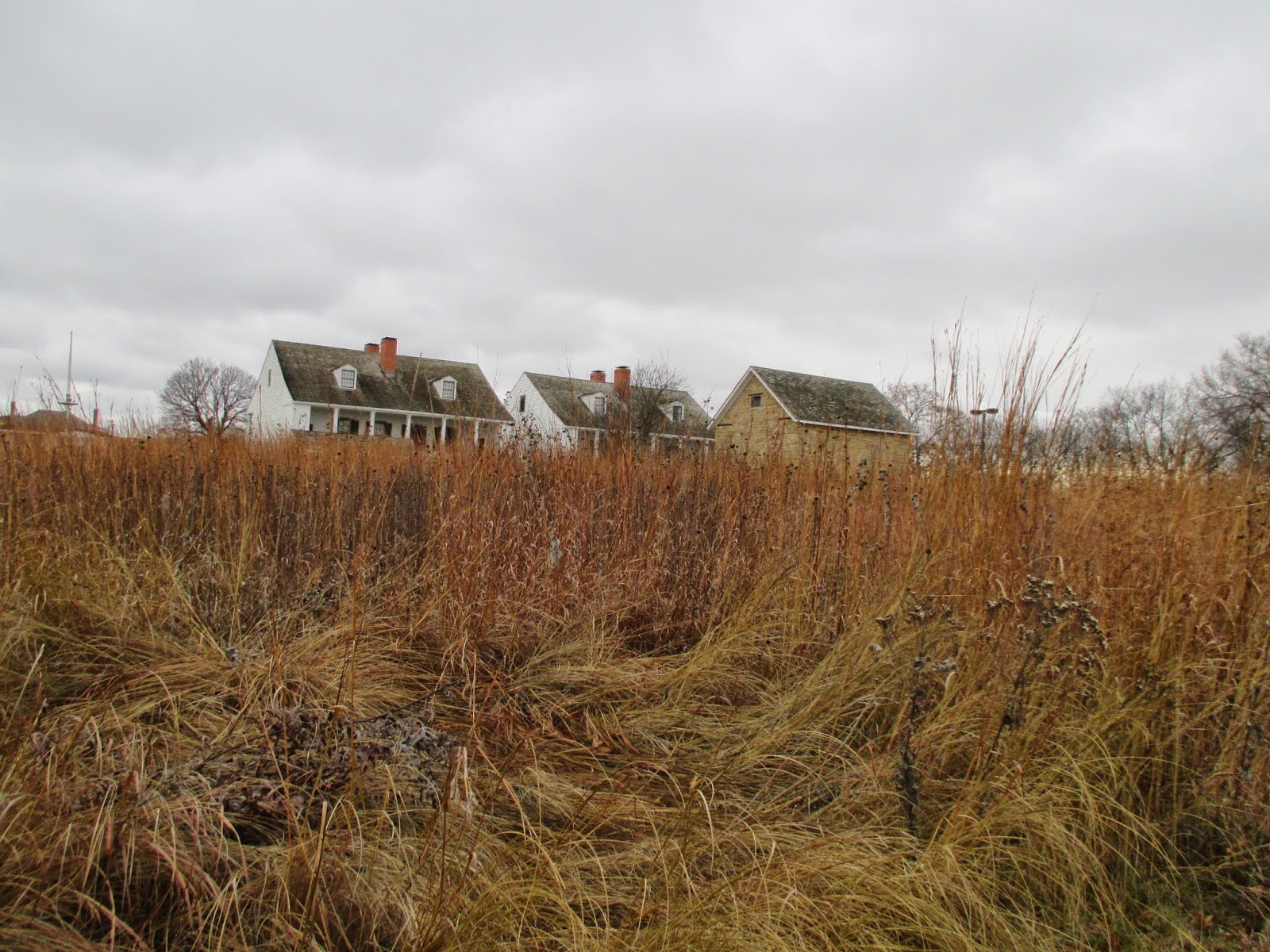
On the east side of the fort's buildings, there's a tallgrass prairie trail.  The trail's not long, but it is pretty amazing to walk through grasses that are 6-7 feet tall!  I especially liked some of the pictures taken from the tallgrass prairie trail.  The buildings had a timeless quality to them with the tall grasses in the foreground. 
The officers quarters were definitely the nicest.  I don't think much has changed in the army in 175 years.  If you're thinking about joining the military, doing so as an officer is the best way to go. 
 
The stables where the dragoons, a precursor to what would become the cavalry, kept their horses was a neat stop as well.  There was a well designed exhibit that showed different saddles and tack (reigns and other horse riding accessories) that were used, as well as one that showed how horses were selected by color and size for the different companies of dragoons.  The combination of the dragoons and the old fort made me remember our visits to Fort Bowie in Arizona. 
We had a great visit to Fort Scott.  It's definitely worth visiting.  It's actually quite disappointing to see the visitation numbers for Fort Scott, less than 26,000 people in 2013.  Especially when you compare how close it is to Kansas City (less than 100 miles).  If you're thinking of visiting Fort Scott, do it!  It's a great history lesson and it's really not that far away!

Nearest City: Ft Scott, KS
Location: Just off of the freeway exit, 95 miles south of Kansas City
Time Needed: 1-4 hours
Difficulty: easy
Kid Friendly: yes
Additional Info: Fort Scott NHS Website